
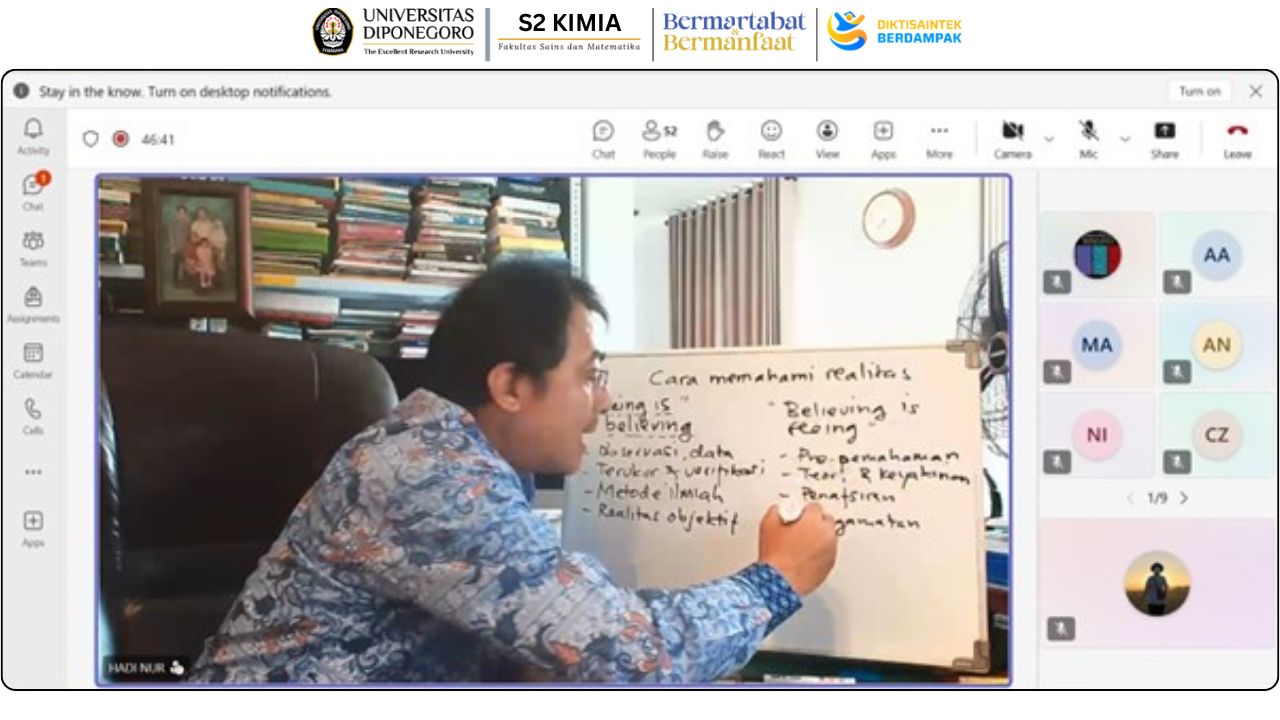
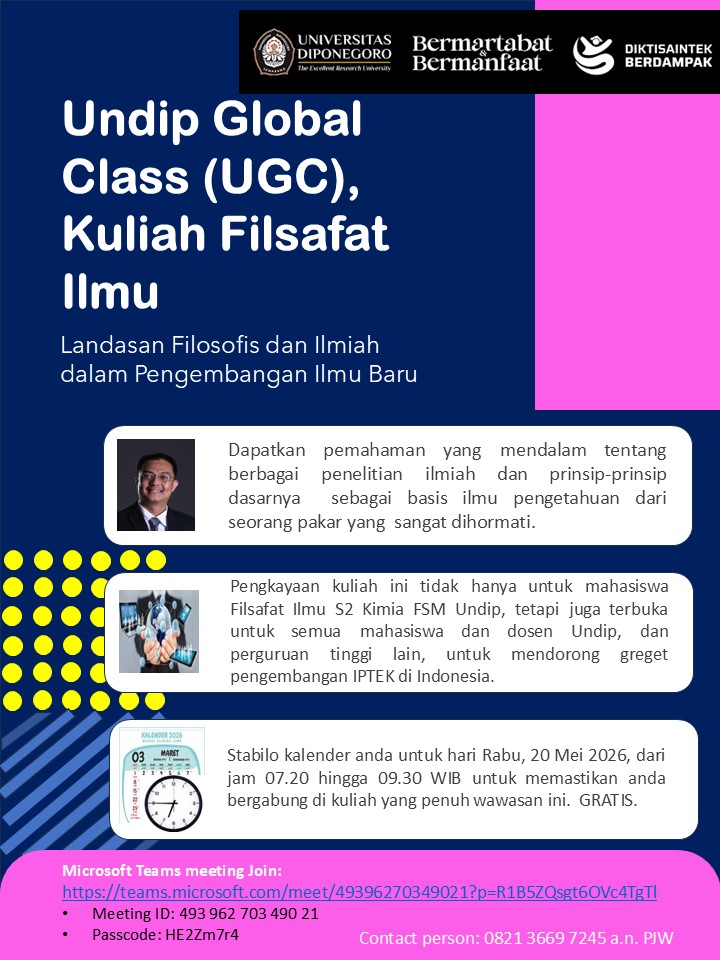
SEMARANG – The Master’s Program in Chemistry at Universitas Diponegoro (UNDIP), under the Universitas Diponegoro Global Classroom (UGC) scheme, held the second session of its Philosophy of Science lecture on May 20, 2026, under the theme “Philosophical Foundations for the Development of New Scientific Knowledge.” The lecture featured Prof. Hadi Nur as the keynote speaker and was broadcast live through UNDIP’s official YouTube channel. https://www.youtube.com/watch?v=EKJImoUB588&t=181s
At the beginning of his presentation, Prof. Hadi introduced two fundamental approaches to scientific inquiry. The first, “Seeing is Believing,” represents the traditions of Empiricism and Positivism, which maintain that knowledge and truth are established through observation and empirical evidence. The second, “Believing is Seeing,” reflects the perspectives of Hermeneutics and Constructivism, emphasizing that beliefs, prior understanding, and conceptual frameworks shape the way individuals perceive reality. According to Prof. Hadi, understanding the dialectical relationship between these two perspectives is essential for developing new scientific knowledge.
Prof. Hadi also demonstrated the practical application of philosophy through Fuzzy Logic Analysis, illustrating how it can be used to examine ethical dilemmas in scientific research and decision-making.
The lecture continued with a discussion of the internal and external factors that influence scientific development. From the internal perspective, Prof. Hadi explored Viktor Frankl’s Existentialism, highlighting three core values: Creative Value, Experiential Value, and Attitudinal Value. He emphasized that love serves as the spiritual source of strength for researchers, encouraging scientists to preserve meaning and purpose despite the pressures of modern academic systems. He argued that existential transformation is essential for researchers to remain resilient, productive, and committed to meaningful scientific contributions.
From the external perspective, Prof. Hadi examined the roles of Social Philosophy, Political Philosophy, and Institutionalism in shaping scientific progress. A discussion with Prof. Jujur addressed the strategic utilization of Indonesia’s natural resources, while Prof. Tri Windarti reflected on the collapse of Indonesia’s sugar industry as a case study illustrating how misguided public policies can have long-term consequences for national development.
The lecture also explored several critical philosophical perspectives. Drawing on the ideas of Paulo Freire, Prof. Hadi discussed the challenges faced by intellectuals working under restrictive institutional systems. He further introduced the concepts of Virtue Ethics and the Cobra Effect to demonstrate how policies implemented without ethical awareness and human-centered considerations may produce outcomes opposite to those originally intended.
In the closing session, Prof. Hadi highlighted the growing challenge of research commercialization, reminding participants of the importance of preserving Creative Value so that scientific research remains driven not solely by financial gain, but also by curiosity, innovation, and the pursuit of knowledge for the benefit of society.
The lecture concluded with closing remarks from Prof. Hadi Nur, followed by a certificate presentation ceremony. Through the Universitas Diponegoro Global Classroom (UGC) program, UNDIP continues to foster the development of scholars who are not only scientifically accomplished but also grounded in ethical principles and humanitarian values.