

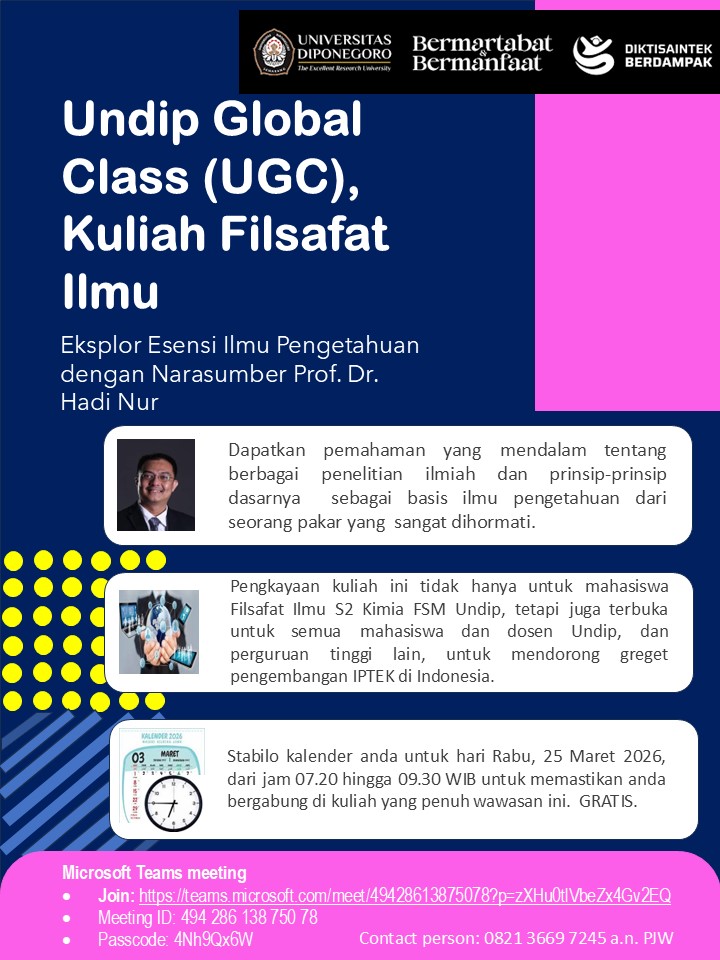
SEMARANG – The Master’s Program in Chemistry at Universitas Diponegoro (UNDIP), under the Universitas Diponegoro Global Classroom (UGC) scheme, held the first session of its Philosophy of Science lecture on Wednesday, March 25, 2026. Carrying the theme “Exploring the Essence of Scientific Knowledge,” the event featured Prof. Hadi Nur as the keynote speaker and was broadcast live through UNDIP’s official YouTube channel.
In his presentation, Prof. Hadi Nur opened the lecture by discussing the Human Thinking System based on the theory of Daniel Kahneman. He explained that human cognition operates through two distinct systems. System 1 functions quickly, intuitively, and automatically in responding to everyday situations, while System 2 works more slowly, analytically, and rationally when dealing with complex problems that require careful deliberation.
Prof. Hadi also emphasized the importance of recognizing cognitive biases, such as the halo effect, which frequently arise when decisions rely primarily on System 1 thinking.
The lecture then moved on to Plato’s Stages of Knowledge. Prof. Hadi explained four levels of knowledge: Doxa, knowledge based on opinion and myth; Episteme, rational knowledge acquired through scientific inquiry; Sophia, meaning the love of wisdom and the origin of the Doctor of Philosophy (Ph.D.) degree; and Truth, the highest level of understanding attained through philosophical reflection and profound insight.
To illustrate humanity’s journey toward truth, Prof. Hadi presented Plato’s Allegory of the Cave. In this famous allegory, prisoners who can only see shadows projected on a cave wall symbolize individuals trapped by opinions, perceptions, and illusions. The act of “leaving the cave” represents the intellectual pursuit of discovering objective reality.
The discussion continued with an overview of major philosophical perspectives in science, particularly the distinction between Scientific Realism and Anti-realism. Prof. Hadi also highlighted Karl Popper’s concept of falsification, which argues that a scientific theory must be testable and capable of being proven false in order to qualify as scientific. In addition, he discussed Thomas Kuhn’s theory of scientific revolutions and paradigm shifts, emphasizing their role in driving the advancement of scientific knowledge.
In the closing session, Prof. Hadi addressed the important topic of Research Ethics and the Future of Artificial Intelligence (AI). He pointed out the growing gap between the ideals of the scientific method and the realities of modern research, where publication pressures may encourage rushed scientific practices. Regarding AI, Prof. Hadi cited the views of Roger Penrose, who argues that genuine intelligence requires not only computational capability but also consciousness and understanding—qualities that artificial intelligence has yet to achieve.
Through this UGC lecture, the Master’s Program in Chemistry at UNDIP aims to broaden the academic perspectives of students and the wider community on the philosophical foundations of scientific thinking, while encouraging critical reflection on the challenges and opportunities presented by science and technology in the digital era.
The full recording of the first Philosophy of Science lecture is available on Universitas Diponegoro’s official YouTube channel. https://www.youtube.com/watch?v=yjF8tJ91nGw&t=32s