
UNDIP Global Classroom Explores DFTB Parameterization in Molecular Modeling Lecture
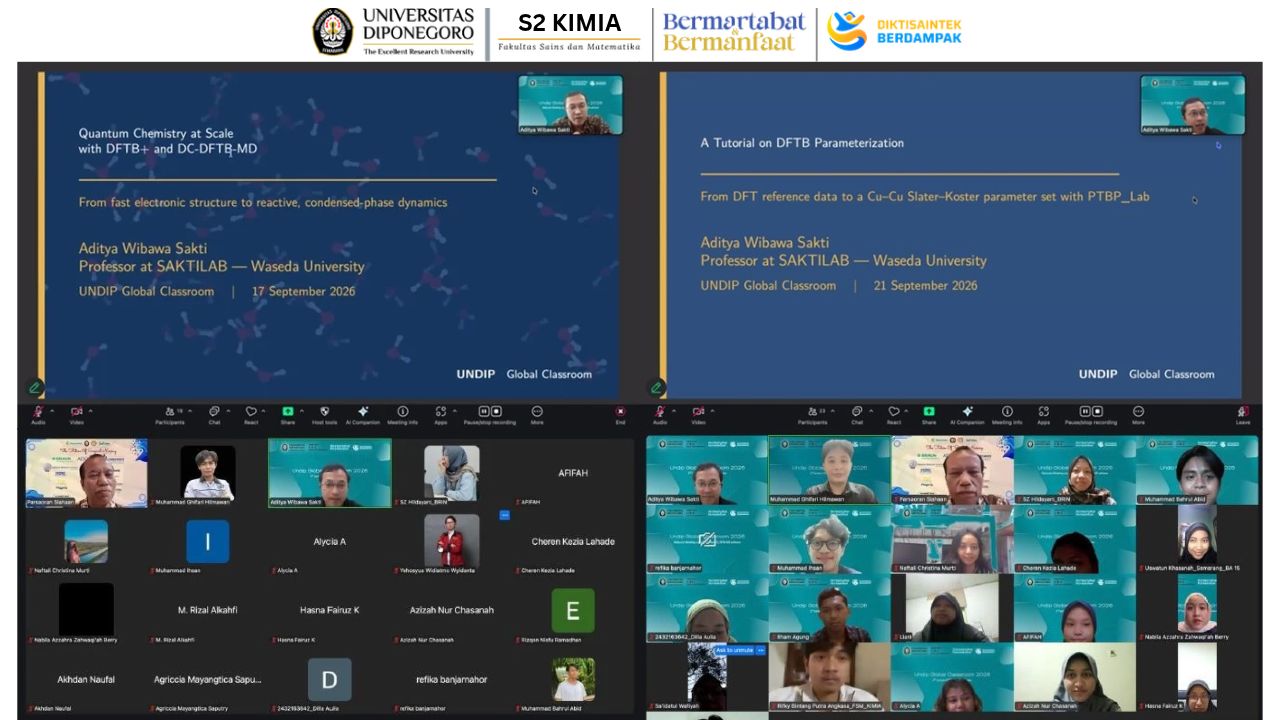
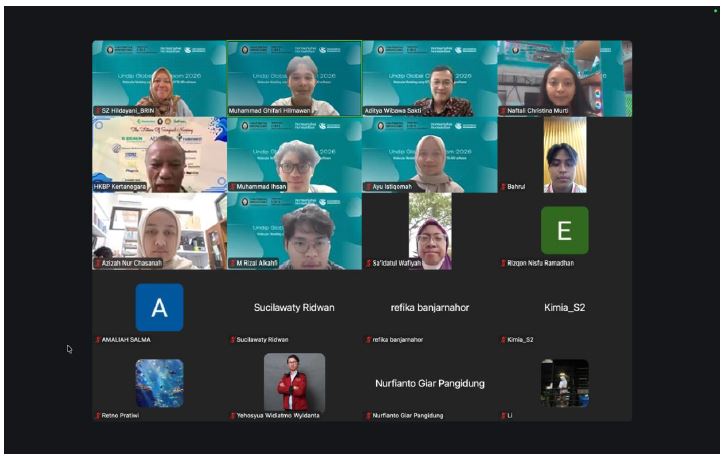
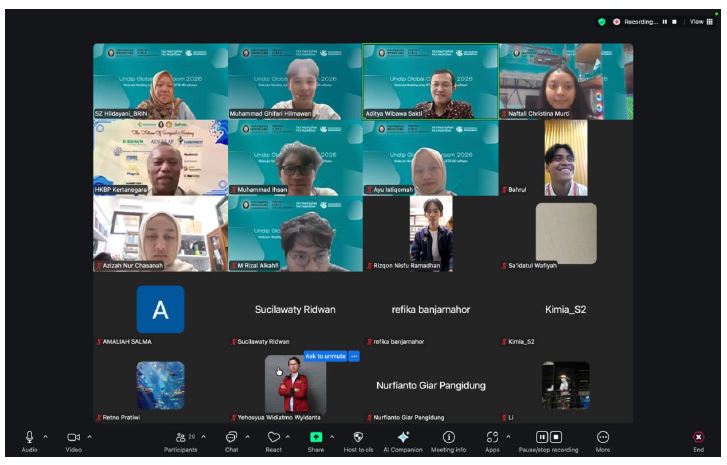
Semarang, September 2026 — The UNDIP Global Classroom (UGC) program continues to strengthen international academic engagement through an online lecture titled “A Tutorial on DFTB Parameterization” on Thursday, September 17, 2026. The session attracted around 40 participants, mainly master’s students enrolled in the Molecular Modeling course.
The lecture featured Prof. Aditya Wibawa Sakti, D.Sc., Professor at SAKTILAB, Waseda University, as the speaker. Prof. Dr. Parsaoran Siahaan, lecturer for the Molecular Modeling course, moderated the discussion.
The session introduced participants to Density Functional Tight Binding (DFTB), an efficient computational method for studying molecular and material systems. It also provided practical insights into DFTB parameterization and its role in advancing computational chemistry research.
Understanding DFTB and Its Applications in Computational Chemistry
In the first session, Prof. Aditya Wibawa Sakti introduced the fundamentals of quantum chemistry using the DFTB method. He discussed two computational tools commonly used in this field: DFTB+ and DC-DFTB-MD.
He explained the key differences between the two software packages, including the scalable dynamics feature available in DC-DFTB-MD. This feature can significantly accelerate simulations, with reported performance improvements of up to 100 times under suitable conditions.
These capabilities make the method valuable for studying large and reactive systems. Examples include chemical bond breaking, proton shuttling, and interfacial processes in lithium-ion batteries and catalytic materials.
Through these examples, participants gained a clearer understanding of how computational chemistry can help researchers investigate complex molecular interactions and material properties.
A Practical Tutorial on DFTB Parameterization Using PTBP_Lab
The second session focused on DFTB parameterization using PTBP_Lab. The goal was to generate accurate Slater–Koster parameter files (.skf) based on reference data obtained from Density Functional Theory (DFT) calculations.
Prof. Aditya explained that parameterization is a challenging and specialized research process. When conducted rigorously, it can support high-impact scientific publications, including research in journals such as the Journal of Physical Chemistry.
The tutorial outlined several key stages of the parameterization process:
- Collecting reference data: Preparing reliable DFT data to guide the parameterization process.
- Building the electronic component: Using PTBP_Lab to construct the electronic part of the model.
- Adjusting electronic confinement: Optimizing the confinement settings to improve the model’s performance.
- Fitting the repulsive potential: Matching the short-range repulsive potential to the reference data.
- Generating Slater–Koster files: Producing .skf parameter files for subsequent DFTB calculations.
This step-by-step explanation helped participants understand the technical workflow behind DFTB parameterization. It also highlighted the importance of reliable reference data and careful parameter fitting in computational chemistry.
Strengthening Molecular Modeling Research Through International Collaboration
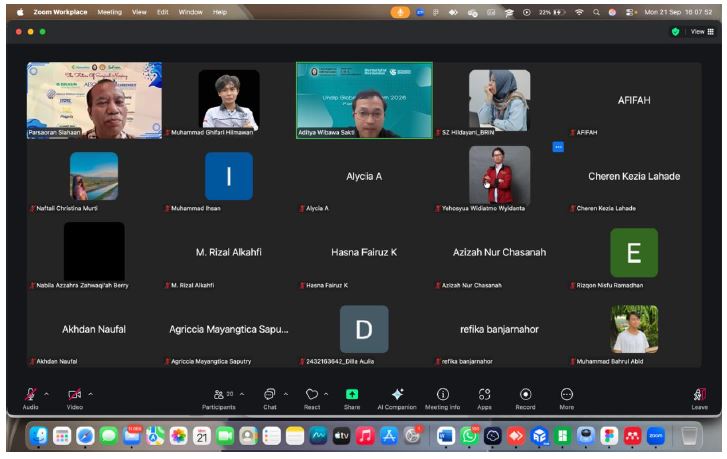
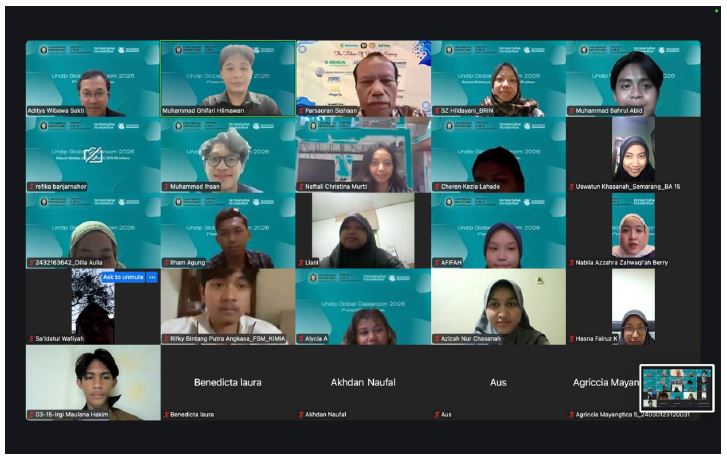
At the end of the lecture, Prof. Dr. Parsaoran Siahaan emphasized the importance of understanding the fundamental principles of molecular modeling.
He noted that a strong theoretical foundation remains essential as many research projects increasingly focus on practical applications. A deeper understanding of computational methods enables researchers to evaluate their models more critically and develop more reliable research approaches.
Through the UNDIP Global Classroom program, the Department of Chemistry, Faculty of Science and Mathematics (FSM), Universitas Diponegoro, continues to promote interactive, internationally oriented learning.
The program provides students and lecturers with opportunities to explore emerging scientific developments, exchange knowledge with international academics, and strengthen global research networks.
The lecture on DFTB parameterization also demonstrated the value of combining theoretical understanding with practical computational skills. By engaging with advanced methods in computational chemistry, participants can broaden their academic perspectives and support future research in molecular modeling, materials science, and catalysis.
Through initiatives such as UGC, the Department of Chemistry at Universitas Diponegoro remains committed to fostering an international academic environment and advancing research excellence.
Keywords: UNDIP Global Classroom, DFTB parameterization, molecular modeling, computational chemistry, PTBP_Lab, DFTB+, Density Functional Theory, Universitas Diponegoro.